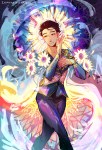
Yuuri is the sun because he has shining potential that is
constantly blocked behind clouds of self-doubt and anxiety. he shines most when
he overcomes his internal demons and reconciles with his emotions; after loss
and darkness, the sun always rises anew
Victor is the moon because he reflects light and brilliance
in the most beautiful and inspiring ways, and yet the shines of medals and victories is all
he is known by; Victor himself is an enigma hidden behind a veil of stars
Why is Yuuri such a drunk demon, please someone stop him at once (´༎ຶ༎ຶ)/♥ Be sure to visit my store, I just made some cute Victuuri wedding acrylics!♥
you know what’s really genuinely unsettling? the degree to which men fucking do not want to sympathize with/be interested in women.
male audiences will happily watch a dozen superhero shows, but then something like Agent Carter or Supergirl turn up and they’re panned from the first trailer and have to struggle for ratings. male audiences will watch countless installments of a franchise as long as it’s about men doing man things but the second a character like Rey or Furiosa or god forbid four entire female Ghostbusters steps up and takes a position of prominence it’s “pandering sjw bullshit”.
it’s not pandering. men just aggressively don’t want to have to be invested in a woman’s narrative and it’s really gross.
anyway re: everyone telling me to “Stop making this a gender thing” or some variation on that
this isn’t like… an opinion I’m pulling out of my ass here? this starts where earlier than tv shows and hollywood blockbusters, when all the kids in a class are reading Harry Potter or Percy Jackson or Eragon o Lord of the Rings or Maze Runner or whatever the hip book is right now. the books like that, the ones that become popular reading, are overwhelmingly about male leads, because male is still considered the default.
there’s a split in YA literature, between books that are “for everyone” and “for girls”, and that’s honestly the entire issue in a tiny little box right there. stories about men are supposed to be accessible for everyone, but stories about girls are seen as 1.) inherently for women and 2.) something that only women will care about.
men grow up in a society that doesn’t make them go out of their way to get into the heads of women and empathize with then. historically it’s been very easy for men to not engage with female-led media if they don’t want to, whereas (like someone else commented on this post) girls and women have had very little choice in the past because everything was about men. we didn’t even question it.
and now the women are arriving in mainstream media in ways that say they’re important and they matter and
small (or sometimes not so small) but loud-enough-to-be-acknowledged groups of men lose. their. shit.
because they think there’s something inherently Not For Them about a woman’s story, and they never learned how to deal with it.
(also once again, because LOT of ya’ll don’t seem to get this here: I’m trying to talk about knee-jerk reactions to female-centered works – often before they even come out. not whether or not you personally thought [x show or movie] was good. ya feel?)
i don’t think i’ve ever read a single post that i’ve agreed with so totally and so immediately and here’s why:
i love books, right? and from the ages of about 11-15 i was insanely invested in teenage/ya fantasy and sci-fi. harry potter, percy jackson, all of the books op listed above- and one of the things that made those books so great was that you could have a conversation about them with anyone! a lot of the guys in my class also loved this type of genre and i’d often talk about books with them (even my own brother has read all of the books listed above) we’d have long, interesting conversations about these books and it was great.
but then i’d mention something about the hunger games, or the divergent series, or uglies, the raven cycle, mara dyer, the mortal instruments, the selection, etc. and the response would always be the same: either ‘i haven’t read it’ or ‘i couldn’t get into it’ or ‘it doesn’t seem like my type of thing’
even outside of the ya genre, looking at something like contemporary fiction or whatever- do you know how many guys will talk endlessly about the great gatsby or catcher in the rye or any other male-centric novel? but when you bring up something as influential as pride and prejudice or jane eyre or practically /anything/ written by/focused around a woman- you get the same responses as before
society has made it so that women have no choice whether to engage with male-centric stories or not: from children, a big portion of the media we consume focuses on the male perspective and like,,, that’s not necessarily a bad thing /in itself/- the bad thing is that it doesn’t work both ways and it’s not an even split. whereas young girls are surrounded by and expected to empathise with films/books/media concerning men, it’s not the same for young boys: they have narratives that either focus entirely or largely around them.
women have no trouble consuming media that focuses on a male narrative because it’s been labelled as the default, the ‘normal’- whereas men struggle to watch/read anything that doesn’t focus around them because they’ve never /had/ to.
I still think Moana deserved an Oscar for this part
To me, the moral of Moana is that only women can help other women heal from male violence.
The movie starts with the idea that the male god who wronged Te Fiti must be the one to heal her. This seems to make a certain sort of intuitive sense in that I think we all believe that if you do something wrong you should try to make it right. But how does he try to right it? Through more violence. Of course that failed.
It was only when another woman, Moana, saw past the “demon of earth and fire” that the traumatized Te Fiti had become (what a good metaphor for trauma, right?) and met her with love instead of violence that she was able to heal. Note that they do the forehead press before Moana restores the heart, while Te Fiti is still Te Kā. Moana doesn’t wait for her beautiful island goddess to appear in all her green splendor before greeting and treating her as someone deserving of love.
Moana is only able to restore the heart because Te Kā reveals her vulnerability and allows Moana to touch her there. Maui and his male violence could only ever have resulted in more ruin.
…this is exactly what I was trying to say and you put it beautifully. @i-want-cheese This is why the scene makes me tear up every damn time. Women’s honest, ugly reaction to trauma is almost never even depicted in films, let alone honored the way it is in Moana. Te Fiti doesn’t have to “rise above” being violated before she’s allowed to heal. Moana sees her and says
I know your name They have stolen the heart from inside you But this does not define you
She utterly accepts Te Fiti’s rage, her fear, her lashing out at anyone who comes near the remains of her ravaged body island. Female ugliness isn’t punished, it’s mourned and loved. What an indescribably comforting moment.











 Nothing but My Aching Soul