oh my GOD great question and also you’re delightful
Here’s the thing: I really really like to be caught off guard by metaphors (even my own). You know when you’re reading & you realize you’ve got arms full of heartbreak or twitchy anger or heady romantic love and you can’t remember ever having made the choice to pick them up?
Like the author describes a sweaty hand slipping on a doorknob over and over to explain anxiety or taking fistfuls of the sky and squeezing until it bruises as a spectacular sunset, and you see things you’ve never seen before, through a film of things you have? That’s when a metaphor has landed.
It’s like meeting someone for the first time, and recognizing them from description alone. The thrill of knowing intimately how something looks on the inside without ever having laid eyes on it.
The main hiccups I see in other people’s writing are that they go too broad or overused i.e: the sky blushed pink, it lulled him to sleep like waves lapping at the shore, I felt anger boil my blood, her bruises were like galaxies, w/e it’s all been done kind of.. to death?
It’s helpful to zero in on really specific feelings; try to find the precise way something makes you feel, and chances are it’ll be both particular to you and available to others, if that makes sense?
Like rain isn’t just wet or sweet-smelling or overwhelming – it wants to know you better, it has a temper the same way your temperamental shower-head has a temper, it pelts birds and bugs off course, it holds the heads of flowers under water until they gasp and bloom, it gathers you close and releases you laughing, it warps your glasses into kaleidoscopes, it smells like walking to school when you were eight years old, looking at the puddles and thinking that the reflections of the sky were portals to the clouds
Like.. that’s me, that’s me staring really hard at the rain right now and finding my way to things I’ve ever thought or wondered about it, but it’s also not at all exclusive to me. And go weirder, get a little harder to understand, describe relief as standing in a parking garage with your keys biting into your hands and your heart eating itself whole, realizing that you’re on the wrong level, and your car hasn’t been stolen.
and don’t be afraid to….. leave it at that
the more you explain yourself the more the plot loses drive and coherency
like unfortunately not many people want to sit in a room and listen to someone fumble their way to the heart of a metaphor, which sucks bc I still do that! I want everyone to see exactly what I see, but it’s like firing arrows closer and closer to the bullseye and then finally hitting it after a page full of close calls. And you have to do that, do all the work, but then you yank all those practice arrows out and you’re left with your dead centre.
And some straight up don’t work. I sat and thought about how I could make a silly little metaphor about reflexively jolting forward when you see a green light in an intersection ahead of your own be about social inequality for 10 minutes yesterday, and then I scrapped it.
(Put the bad ones in a book for later. At some point they’ll be.. not bad.)
So I mean, be fearless with your descriptions, make them personal, and don’t mercy kill the dumb ones until you’re sure they’re suffering. Take lots of inspiration from wherever you can (but don’t copy and paste – I used to be so tempted by other people’s metaphors, hurricanes of curls and rooftops gilded with sunlight, but they didn’t taste the same coming up as they did going down), write a lot a lot a lot to hone in on your style, just bc mine is drippy with overwrought similes doesn’t mean yours has to be
but also like…… comparing writing to a #prime meme is already a really clear, succinct metaphor lmao
Also the fact that you think I know shit, and that you’re being so kind about something I worry I’m hammering into your foreheads.. is really. good. absolutely keep writing until 13 good pages becomes 13 perfect words 💕
the politics of light and dark are everywhere in our vocabulary…psa to writers: subvert this, reveal whiteness and lightness as sometimes artificial and violent, and darkness as healing, the unknown as natural
Some ideas for bad things that are white/light:
lightning, very hot fire
snow storms, ice, frost on crops
some types of fungus/mold
corpses, ghosts, bones, a diseased person
clothing, skin tone, hair, etc. of a bad person
fur, teeth, eyes of an attacking animal/monster
bleached out deserts, dead trees, lifeless places
poison
Some ideas for good things that are black/dark:
rich earth/soil
chocolate, truffles, wine, cooked meat
friendly animals/pets/creatures
a character’s favorite vehicle, technology, coat, etc.
a pleasant night
hair, skin tone, clothing, etc. of a good person
undisturbed water of a lake
the case/container of something important
valued wood, furniture, art
velvet
Think to burn, to infect, to bleach vs. to enrich, to protect, to be of substance.
completely double spaced version on google docs here – this post is more blocky for the sake of people’s dashboards, but still long so people will be less likely to glaze over it. my apologies if that makes it hard to read
things to look for and avoid in an autistic character
• symptoms only manifesting as “nonverbal and rocking”
• super smart / living calculator
• super dumb / doesn’t understand anything
• all the symptoms you can come up with for them are “awkward” and “has special interest(s)” (please do more research)
• trains, technology, and/or math as special interests
• acting like a child
•
getting treated like a baby
• unreasonably cruel and uncaring about others’ reactions to them being cruel
• if they’re comparable to sheldon from the big bang theory, start over
• animal comparisons
• a lack of feelings
• please no stories about what it’s like to be autistic told by allistics
talking about things outside of special interests (again…. come on……….) (special interests are usually the default things our brains go to when theres no stimulation or we want to entertain ourselves – it isn’t literally all we think or talk about ever. if a conversation has no connections to a special interest, reconsider having your autistic character bring it up in a context that is not an introduction.)
•
explicitly expressed to be capable of attraction and romantic feelings – if your character is an adult, add sexual feelings to this point
•
capable of general functioning, just with a disability that makes it more difficult – not a walking disability (….sigh)
• a wide amount of feelings and emotional turmoil (but perhaps only being able to express it in limited ways)
• we’re people
• just people whose brains are wired differently
things to avoid in research for an autistic character
•
autism moms / autism blogs and websites not run by autistic people
•
any affiliation with autism $peaks means you should walk away and never look back
•
a scientist trying to create explanations for what autistic people do without actually asking / not mentioning asking autistic people
• anything about a cure for autism
• a person that “worked with autistic kids” phrased in the same way as “worked with animals”
• talking about autistic people as if they are mysteries, are like animals, or are otherwise othered weirdos instead of people
things to look for in research for an autistic character
•
actual autistic people talking about their experiences and symptoms
• just stick to that and you’re good but it’s hard to find sometimes ngl. just look for the above red flags
things i would personally like to see in an autistic character
• less easy to swallow sadness and more destructive anger. i would love to see a canonically autistic character who was frustrated easily by small things and had trouble communicating why •
not a story about being autistic, a story that happens to have a character or characters who are autistic – it isn’t pointed out or questioned, they’re right at home with the rest of the cast and not othered (a la symmetra from overwatch) •
intensive sensory issues / small sounds making large reactions • clear communications about not liking x sensory thing (for example being touched) •
poor motor skills / clumsiness and not being laughed at for it • walking funny (body bent downwards, walking very fast, walking slowly,
big strides, shuffling, stiffness, etc) – no one treats it as if it’s funny or something totally strange • a big personality that has a presence so they can’t be cast aside (but feel free to have quiet characters too) – if this was along with being nonverbal they would probably leap to being one of my favorite characters ever • a fear of asking for clarification on sarcasm or jokes because of past experiences and an arc about the character becoming more comfortable asking questions
>> if any fellow autistic people want to add something, feel free <<
allistics are encouraged to rb this
oh man thank you so much for this! i’ve been trying to quietly develop a character i’ve had for years and the story he’s in, and i’ve been seriously considering him being autistic/having aspergers syndrome, and i’ve been having trouble finding info that’s not from Autism Speaks or something similar
i wanted to post on this because i’d like feedback from anyone who has the background to do so about something that this post pointed out: this character of mine is based in a sci-fi story, and is an alien (not the best representation, i know, but there are very few humans in the plot, so i figured one of the lead characters being autistic would at least be something positive). his species are sentient, intelligent and bipedal, much like humans, but are somewhat animal-like when it comes to appearance and some behaviours. would it be insensitive/offensive to have an autistic character be a member of such a species? animal comparisons were listed in the DO NOT section, which is completely understandable, so i could really use some feedback
Writing is a craft. It takes time for anyone to learn
and improve. But there are some shortcuts you can try, maybe adapt to your own needs. Here are 11 writing problems and their solutions, or hacks.
Too many ideas syndrome
Problem: You have too many equally good story ideas
and can’t pick just one to write.
Solution: Select your top 3 favorite stories and
write the first scene of all three. If you can’t decide, write
the first
chapter. The right project will be easier to work with, you’ll have
fun writing it, you will be daydreaming about the story, you will
love the characters. So, give away three chances instead of one.
Outline spoiling the fun
Problem: Whenever you outline a story idea, it
completely spoils your will to write it. The mystery is gone.
Solution: Instead of outlining the whole story, just
make a clear goal on how your characters should end. Will they
succeed? Will they fail? Will they be happy? Will they find
redemption? Will they be wronged? Decide how your story should end
and explore the plot as you go. Remember, no one will read your
first draft, so just write.
Lost midway
Problem: If you are a pantser, you might get lost in
the middle of the story, especially after the first plot point.
Solution: Give your story an ending. If you know where
your characters will end up, you’ll have a better understanding of
which routes to take. Always keep in mind how the story will end. Use
it as the beacon of a lighthouse to guide you through stormy waters.
Creative block
Problem: You don’t have story ideas. Or nothing you
have so far excites you enough for a novel.
Solution: Read a book or watch a movie completely out
of your genre. This works like magic, I promise. I’m not a sci-fi
person, but Akira has given me more story ideas than any movie and
book from my own genre.
Writing anxiety
Problem: You are scared of writing, scared of
starting a new story, or just scared of not doing a good job.
Solution: Write a fanfic. No one expects a fanfic to
be a masterpiece (although many are). Fanfics are done for fun and for
passion. So, write your book in fanfic format. You can even use
fandom characters and aus in the process. When the story is
completed, change back to original characters.
Editing as you write
Problem: You keep going back to previous paragraphs
and editing instead of moving forward with your writing.
Solution: Write your novel by hand. This might sound
like a lot of work, but it’s quite the opposite. The white screen
of the computer urges you to review, to make it perfect, academic
like perfect. The paper however, brings you back to the craft, to the
urge of filling lines and pages. Handwriting also gives you the
opportunity of sketching and doodling.
Solution: Go offline. Turn off your wi-fi. Use a
device without internet connection. Or, if you keep fooling yourself
and turning the internet back on, write your novel by hand. Give
yourself a daily hour of internet, but live offline. And if you take unnecessary trips to the fridge or the bathroom, try the pomodoro technique.
Lack of plots
Problem: Nothing relevant is happening, your story
looks kind of boring. Or the main plot is too weak for a whole novel.
Solution: Take a few days off. Just relax. When you are ready to go back, read what you have written so
far. Maybe you were just tired. But, if
the story really sucks, go back to basics. Ask yourself two questions.
What type of story am I writing? How will this story end? Follow the
answer like a map. Change what needs to be changed, even if you have
to delete the whole progress. If you lack plots, don’t add fillers, just go back to basics.
Weak main character
Problem: Your
character
lacks personality, voice and/or visuals.
Solution: Give your main character three things. An
external battle. An internal battle. And an unique feature. The external
battle is their goal, what they want to achieve, what they dream
about. An internal battle is their fears, traumas, doubts, mental
issues, prejudices and triggers to overcome. An unique feature is what sets them
apart from other characters, maybe they have piercings, or tattoos,
or pink hair, or lilac eyes, maybe they wear neon boots, or a mask,
or mittens, maybe they are left-handed, or blind, maybe they have a scar, or a
birthmark. Every amazing main character has external battles,
internal battles and unique features.
Depression
Problem: You have no will to write. The passion is
gone. You feel empty.
Solution: If you don’t
have access to medical help, reading is a good way to reevaluate your
career and regain your passion for the words. Read lots of books.
Don’t worry about writing, just read. Lose yourself in fictional
adventures. Read sci-fi, romance, horror, fantasy, crime, family
saga, classics, foreigner fictions, fanfics, shorts, poetry. Immerse
in literature. Literature can save lives.
Strange dialogues
Problem: Dialogues seem too formal, or too much like
the narration, or characters lack individuality.
Solution: Read your dialogues out loud while acting
as your characters. You can find a quiet empty room for that. Be an
actor. Go for the emotions. Record your acting sections, after all,
you might improvise at some point.
Do an
outline, whatever way works best.
Get yourself out of the word soup and know where the story is headed.
Conflicts
and obstacles. Hurt the protagonist, put things in their way, this keeps
the story interesting. An easy journey makes the story boring and boring is
hard to write.
Change
the POV. Sometimes all it takes to untangle a knotted story is to look at
it through different eyes, be it through the sidekick, the antagonist, a minor
character, whatever.
Know the
characters. You can’t write a story if the characters are strangers to you.
Know their likes, dislikes, fears, and most importantly, their motivation. This makes the path clearer.
Fill in
holes. Writing doesn’t have to be linear; you can always go back and fill in plotholes,
and add content and context.
Have
flashbacks, hallucinations, dream sequences or foreshadowing events. These
stir the story up, deviations from the expected course add a feeling of urgency
and uncertainty to the narrative.
Introduce
a new mystery. If there’s something that just doesn’t add up, a big question mark, the story becomes more
compelling. Beware: this can also cause you to sink further into the mire.
Take
something from your protagonist. A weapon, asset, ally or loved one. Force
him to operate without it, it can reinvigorate a stale story.
Twists
and betrayal. Maybe someone isn’t who they say they are or the protagonist
is betrayed by someone he thought he could trust. This can shake the story up
and get it rolling again.
Secrets. If
someone has a deep, dark secret that they’re forced to lie about, it’s a good
way to stir up some fresh conflict. New lies to cover up the old ones, the
secret being revealed, and all the resulting chaos.
Kill
someone. Make a character death that is productive to the plot, but not “just because”. If done well, it affects
all the characters, stirs up the story and gets it moving.
Ill-advised
character actions. Tension is created when a character we love does
something we hate. Identify the thing the readers don’t want to happen, then
engineer it so it happens worse than they imagined.
Create cliff-hangers. Keep the readers’ attention by putting the characters into new problems and
make them wait for you to write your way out of it. This challenge can really
bring out your creativity.
Raise the
stakes. Make the consequences of failure worse, make the journey harder.
Suddenly the protagonist’s goal is more than he expected, or he has to make an
important choice.
Make the
hero active. You can’t always wait for external influences on the
characters, sometimes you have to make the hero take actions himself. Not
necessarily to be successful, but active
and complicit in the narrative.
Different
threat levels. Make the conflicts on a physical level (“I’m about to be
killed by a demon”), an emotional level (“But that demon was my true love”) and
a philosophical level (“If I’m forced to kill my true love before they kill me,
how can love ever succeed in the face of evil?”).
Figure
out an ending. If you know where the story is going to end, it helps get
the ball rolling towards that end, even if it’s not the same ending that you
actually end up writing.
What if?
What if the hero kills the antagonist now, gets captured, or goes insane? When
you write down different questions like these, the answer to how to continue the
story will present itself.
Start
fresh or skip ahead. Delete the last five thousand words and try again. It’s
terrifying at first, but frees you up for a fresh start to find a proper path. Or
you can skip the part that’s putting you on edge – forget about that fidgety
crap, you can do it later – and write the next scene. Whatever was in-between
will come with time.
*Blinks* I-I’m not the only one to call writer’s block needing to un-stick the story?
Okay,
so. I saw a post this morning about why talking about writing is easier than
writing most of the time summed up with, “Well, it’s immediate gratification,”
and how even writing fic online is easier than writing an MS for publication. But
it didn’t come with any tips on how to overcome it.
I
originally wanted to write this as a reblog to that post, but I can’t find it,
so here we are.
Alpha readers. Alpha readers are people
who read along as you draft (the first draft) and tell if you they notice
plot holes, if they like where the story is going, etc. Obviously you can’t
have too many, but having any can be nice.
Brainstorming. I’m going to tell you a secret. “Brainstorming”
is basically just code for, “I wanna talk about my story ideas with
someone because it helps me think about them.” I don’t even always require
actual suggestions. This is largely just an excuse to make “Talking about my
writing” into something useful.
Have someone look over your outline. The first two tips are kind
of geared toward “pantsers” since I tend to be one myself. This one is for
outliners. Once you have the skeleton for your story, give it to someone
for feedback. They’ll point out plot holes, things they’re especially
interested in, whatever you want. Very helpful.
Print your
stuff out or write longhand. This makes your “gratification”
tangible. You’re actually touching what you made. You can touch it. Look how cool that is. Look what you made.
Bonus: you can carry it around when you can’t write and write on breaks,
or just show it off and have people go “wow!” at you.
Writer
friends.
This one is crucial for a lot of reasons, but it’s always nice to have someone
to share a line with and go, “Look at this asshole. Look what they’re
doing now,“ and get a response, or have someone ask a question about what’s
going on.
For those who can’t make it to the Seven Sentences seminar but wish they could, here’s some of my writing advice that I’ve put online (and everything else I’ve written on writing is tagged as how-i-write on Tumblr):
IF IT HAS BEEN A VERY LONG DAY, YOU ARE ‘WEARY’. IF SOMEONE IS ACTING IN A WAY THAT MAKES YOU SUSPICIOUS, YOU ARE ‘WARY’.
ALL IN ‘DUE’ TIME, NOT ‘DO’ TIME
‘PER SE’ NOT ‘PER SAY’
THANK YOU
BREATHE – THE VERB FORM IN PRESENT TENSE
BREATH – THE NOUN FORM
THEY ARE NOT INTERCHANGEABLE
WANDER – TO WALK ABOUT AIMLESSLY
WONDER – TO THINK OF IN A DREAMLIKE AND/OR WISTFUL MANNER
THEY ARE NOT INTERCHANGEABLE (but one’s mind can wander)
DEFIANT – RESISTANT DEFINITE – CERTAIN
WANTON – DELIBERATE AND UNPROVOKED ACTION (ALSO AN ARCHAIC TERM FOR A PROMISCUOUS WOMAN)
WONTON – IT’S A DUMPLING THAT’S ALL IT IS IT’S A FUCKING DUMPLING
BAWL- TO SOB/CRY
BALL- A FUCKING BALL
YOU CANNOT “BALL” YOUR EYES OUT
AND FOR FUCK’S SAKE, IT’S NOT “SIKE”; IT’S “PSYCH”. AS IN “I PSYCHED YOU OUT”; BECAUSE YOU MOMENTARILY MADE SOMEONE BELIEVE SOMETHING THAT WASN’T TRUE.
THANK YOU.
*slams reblog*
IT’S ‘MIGHT AS WELL’. ‘MIND AS WELL’ DOES NOT MAKE GRAMMATICAL SENSE.
IT’S NOT ‘COULD OF’, THAT DOESN’T MAKE ANY SENSE WHATSOEVER. IT’S ‘COULD HAVE’. SAME APPLIES TO ‘SHOULD HAVE’.
And this is why my students look at me as though I’m the devil when I try to tell them that no i’m not lying this really is a thing
EAGER MEANS YOU ARE EXCITEDLY LOOKING FORWARD TO SOMETHING ANXIOUS MEANS NERVOUS ABOUT THE UPCOMING THING IF YOURE ANXIOUS FOR VACATION SOMETHING IS WRONG
TO FLAUNT IS TO SHOW OFF. TO FLOUT IS TO DEFY (OFTEN IN A DRAMATIC, SPECTACULAR FASHION, WHICH MAY BE WHY PEOPLE GET CONFUSED).
YOU REIGN OVER SOMETHING, EXERTING POWER AND AUTHORITY AS A KING OR QUEEN WOULD. YOU REIN IN SOMETHING, EXERTING RESTRAINT OVER IT. IT’S A METAPHOR RELATING TO RIDING HORSES.
WHEN ONE IS NONPLUSSED, THEY ARE DISTURBED, DISMAYED OR SURPRISED. IF SOMEONE SHOWS NO REACTION, YOU MIGHT BE LOOKING FOR A WORD LIKE UNFAZED.
QUE IS SPANISH FOR ‘WHAT’ QUEUE MEANS A LINE OF PEOPLE, OR A BRAID OR PONYTAIL. CUE IS THE WORD, BORROWED FROM THEATER, SIGNIFYING ‘AT THIS POINT AN EVENT HAPPENS.’
I don’t know why we’re doing this in all caps, but far be it from me to flout tradition.
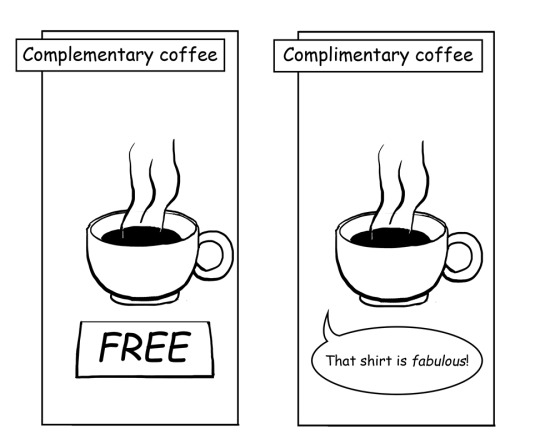
This is a wonderful post, but just a PSA that the coffee example is wrong.
Complimentary coffee is free coffee.
Complementary coffee is coffee that goes with your donut, or breakfast sandwich, or perhaps your outfit. It is, however, not free, unless it is complimentary complementary coffee.





 Nothing but My Aching Soul