sometimes i really love my fics. i wrote that because i wanted to read it. i love it. nobody visits my fics more than me. they remind me that i’m a hard worker, that i created something. it’s mine and i cherish it and love it because it’s exactly what i wanted so i made it.
and other days i’m crippled by self criticism and hate everything and can’t bear to look at my own work because i know it’ll never compare to the greats
but i live for the days i love my work. because it’s mine, and i made it. i didn’t wait for somebody else to make what i dream about. i went and did it myself.
so don’t feel like your work is awful
it’s the stuff you dreamed about. it’s the stuff you decided to make a reality. it’s not about quality, or poetry, or how perfectly your sculpt your words or keep it so deeply in character; because it’s what you dreamed and it’s what you wanted to see, so you made it.
keep writing; it’s yours, and you made it. and if you want to continue to sharpen and improve yourself? then do it. it’s all yours and you can make it whatever you want.
-making the facial expression your character’s making and trying to describe it
-writing entire scenes in your head as you shower and not remembering most of it by the time you get to your computer
-deciding you can’t do something you’ve been looking forward to until you write what you told yourself you were going to write, resulting in you laying in your bed doing nothing
-having two completely different ideas for your story to go in and both seem equally good but you can’t do both and you also can’t choose
-having docs with stories you know you’ll never finish but not deleting them anyway, even if they’re only a couple sentences long
-getting random bursts of productivity that could go towards homework or cleaning your room or writing and you know you’ll only be able to do one
-getting inspiration from the most random things
-writing at inopportune times because a perfect line or dialogue just popped into your head and you have to get it down before you forget it
-“what are you writing?” “……..a story”
– “what do you want to do when you grow up?” “uunnghnnggguughhhhh”
-reveling in the embarrassment you put your characters through
No problem! And sorry about not answering sooner, I was on vacation. To make it up to you, I’ve made one of my trademark Long Posts about it.
TIPS ON HOW TO WRITE PAIN (FOR BOTH ORIGINAL CONTENT WRITERS AND FANFICTION WRITERS)
When I first started writing, about eight years ago, I had the same issue as @imjustafuckinggirl.
How are you supposed to write about pain you’ve never experienced before???
The characters in my book suffer through all sorts of terrible shit, and in no way am I writing from experience, which is marginally easier to do than write about something that has never happened to you.
However, with time, I managed to gather up a few strategies on how to write pain.
1. Don’t Write Paragraphs About It
I know, it’s tempting. You want to convey to the reader just how much pain the character is in, and you think that the pain will be emphasized the more you write about it.
This, however, is a lie.
As a reader, when I’m reading a book or fanfiction where, whenever the writer uses agonizingly long paragraphs to describe when a character is hurt, I skip it.
Entirely.
It’s boring and, quite frankly, unnecessary, especially during a fight or huge battle, which are supposed to be fast-paced.
When it comes to writing about pain, it really is about quality and not quantity.
In my own writing, I stick to short, quick paragraphs, some of them which are barely a line long. This gives it a faster pace and sort of parallels with the scattered, spread out thoughts of the character as they suffer.
2. Describe it Right
Many times, usually in fanfiction, writers over-exaggerate certain injuries.
This partially has to do with the fact that they’ve never experienced that injury before and are just thinking about what it might feel like.
As a girl with two brothers and who often participated in rough play-fights, I can assure you that getting punched is not as painful as you think it is.
(However, it does depend on the area, as well as how hard the punch is, on top of the fact that you have to take into account whether or not the punch broke bones)
I’m reading a high school AU where a character gets punched by a bully (Idk where they got punched it wasn’t stated) and the author is describing it like they’d been shot.
It was to the point where I was like Did the bully have brass knuckles or something????
It was very clear that this author had never been punched before.
When describing the pain of an injury or the injury itself, you have to take into account:
– What object was used to harm the character
– Where the injury is
– How long the character has had the injury
– (For blades) How deep the cut is
– (For blunt force trauma) How hard the hit was
– Whether or not the wound triggers other things (Ex: Concussion, vomiting, dizziness, infection, internal/external bleeding).
There’s also the fact that when some authors described wounds caused by blades such as knives, daggers, and swords, they never take into account the anatomy of a person and which places cause the most blood flow.
Obviously, a cut on your cheek will have less of a blood flow than a cut on your wrist, depending on what the blade hits, and I hope that everyone consults a diagram of veins, capillaries, arteries, etc. when they’re describing blood flow from a certain place.
There’s also the fact that you have to take into account where the blood is coming from. Veins? Arteries?
The blood from arteries will be a brighter red, like vermilion, than the blood from veins, which is the dark crimson everyone likes to talk about.
Not all places gush bright red blood, people!
3. DIFFERENT INJURIES HAVE DIFFERENT KINDS OF PAIN
Here, let me explain.
A punch feels different from a slap.
A broken arm feels different from getting stabbed.
A fall feels different from a dog bite.
I’ll give you a list of all the kinds of things that can be described for the three most common kinds of injuries that happen in stories:
Punch/Blunt Force Trauma
How it feels:
– Aching
– Numbness (In the later stages)
– A single spike of pain before it fades into an ache
– Throbbing
Effects:
– Vomiting (If the character is punched in the gut)
– Swelling
– Bruising
– Broken bones
– Unconsciousness (Blow to the head)
– Dizziness (Blow to the head)
– Concussion (Also a blow to the head)
– Internal bleeding
– Death (In the case of concussions and internal bleeding and broken bones- ribs can pierce lungs)
Stab Wound/Cut
How it feels:
– Stinging (only shallow wounds have just stinging)
– Burning
– With stab wounds, I feel like describing the effects of it make it more powerfully felt by the reader
Effects:
– Bleeding (Consult chart of the circulatory system beforehand for the amount of blood flow that should be described and what color the blood should be)
– Dizziness (Heavy blood loss)
– Unconsciousness
– Infection (if left unattended)
– Death
Gunshot
How it feels:
– Depends on the caliber bullet, from how far away they were shot (point-blank range is nothing like being shot from a distance), and in what place. Do careful research and then make your decision.
Effects:
– Bleeding
(Consult chart of the circulatory system beforehand for the amount of
blood flow that should be described and what color the blood should be. Also take into effect the above variables for blood flow as well.)
– Dizziness (Heavy blood loss)
– Infection (if left unattended)
– Death
Some things that a character may do while they’re injured:
– Heavy/Harsh/Ragged breathing
– Panting
– Making noises of pain
gasping
grunting
hissing
groaning
whimpering
yelping (when the injury is inflicted)
screaming
shrieking
wailing
– Crying/ Weeping/Sobbing/Etc.
– Clenching their teeth
– Unable to speak
– Pressing their hands against a stab wound/cut to try and stem the bleeding
– Eyesight going out of whack (vision blurring and tilting, the room spinning, black spots consuming sight)
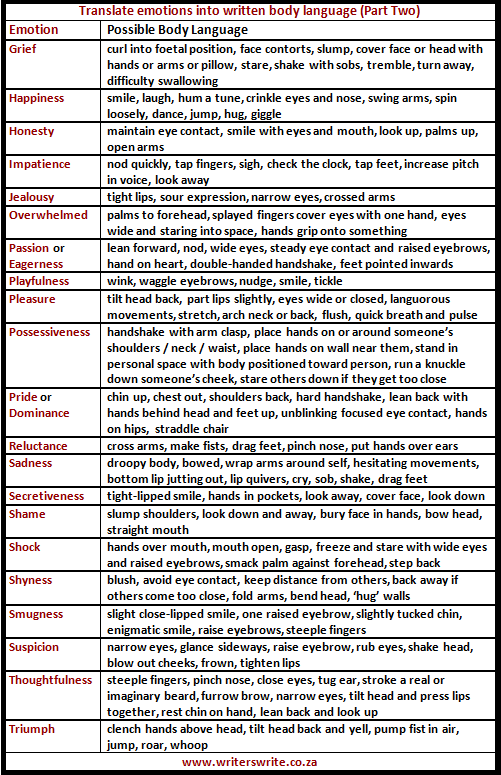
This is something that happens every day in your life. A shift of your eyebrow in skepticism, or the way your lip may twitch to a half smile cause you’re trying not to laugh. These behaviors are vital for writing in character, because not only do the allow you to visually see what is happening but it is also reaffirming whatever emotion your character is showing.
So why should you write it?
Much of human communication is non-verbal which means you need to also translate this non-verbal reaction in a post. It allows you to greatly enhance the emotions of another character and always another person to ‘visually’ see how they feel in a post. Most of all, this will add depth and volume to your post to make it feel more real. IT will make your character feel like a human instead of just another fictional person you look at from above.
Below you will find a list different type of emotions and what sort of body language can be exhibited to them.
Three ways to accent an action.
When writing about emotions, there are different ways to verbally write them out. Each one is unique in their own way, allowing you to show more about the emotion.
Emphasize the Emotion.
But doing this, you are expressing both the emotion and the body language. We’ll use a simple example. It’s short and simple yet you can sense he is happy.
John felt so happy that he was humming a tune while walking down the hall.
Complicate the Emotion.
Sometimes, even when you are feeling one emotion, deep down rooted underneath the facade of it all, there is actually an underlining emotion they feel. This is something you have to truly express otherwise no one will know.
John felt so happy that he was humming a tune while walking down the hall. However, it was obvious by the way his nose crinkled that he was disgusted by the actions beforehand. Instead, John covered it up by appearing pleased today.
Contradict the Emotion.
This is a little different than complicate. Contradicting means that you are claiming one thing when in fact its the other. In many ways, this has a variety of uses, from inner depth of the truth to what you see in person, or someone creating a wall. It could be considered a lie, but when is anything that easy?
John felt so happy that he was humming a tune while walking down the hall. In truth, once he was in the classroom, his shoulders slumped and a pout crossed his lips when no one was around, showing just how displeased he was with the situation.
Remember that you do not always have to contradict or complicate anything. Sometimes all you need to do is emphasize and that will be just fine. You don’t always have to have an underlining complicated for an emotion to make it more enhanced.
Do be afraid to use the Thesaurus to also improve an emotion. Such things as “happy” is a nice emotional word, but think of how much more powerful it is when you heard some is “overjoyed” or “content.” She how these emotions matched up with a body language can give two different styles of happiness? Mix and match to find what works best for your character at the time.
More In Depth Information
What I’ve stated above is more of a simplistic overview. IF you truly want to improve yourself, go to this
To see just how much body language can reveal about a person. You will find things such as how a person lies, how the eyes reaction, the positioning of a person in personal space, mouth, and head body language and so much more.
Use these resources to greatly increase the reactions of your character to another and create a more life-like world.
I understand how fear can be hard to capture, because everybody experiences and shows it differently and because, like all emotions, it has calibers and gradients. I think I can help you on both accounts.
Firstly: Types of fear. (I haven’t ranked these in any particular order.)
1. Anxiety: defined as “a feeling of worry, nervousness, or unease, typically about an imminent event or something with an uncertain outcome”. Separate from the disorder, when I think of anxiety I think of nail-biting, eyebrows drawn together, sweating. Anxiety is like nervousness, but heavier.
2. Nervousness: defined as “the quality or state of being nervous”, and nervous is defined as “easily agitated or alarmed; tending to be anxious; highly strung”. Nervousness is more when you don’t know whether the outcome of something is going to be good or bad (the typical fear of the unknown), whereas anxiety is the fear of a bad outcome.
3. Horror: defined as
“
an intense feeling of fear, shock, or disgust”. Horror is fear mixed mainly with disbelief or shock: for example, a scene after a shooting on the news might horrify somebody, or an account of things done at the Auschwitz camps might horrify someone.
4. Terror: defined simply as “extreme fear”. Terror is the most unadulterated of these emotions – it’s strong, bright, pure fear, plain and simple.
5. Dread: defined as “great fear or apprehension”. Dread is similar to anxiety, but heavier even than that, because the feeling implies that you already know the outcome is not good, whereas anxiety expects a bad outcome but isn’t sure.
6. Panic: defined as “sudden uncontrollable fear or anxiety, often causing wildly unthinking behavior”. This is the child of terror – the need to do something causes you to do anything.
I think that’s it for emotions – now for how to show them. (Keep in mind you don’t have to use every single one of these mannerisms/feelings for every single character – it really depends on the person.)
1. Anxiety: lip-biting, nail-biting, foot-tapping, leg-tapping, laughing a lot, falling very quiet, being irritable, panic attacks (crying, hyperventilating), shaking, nausea
2. Nervousness: queasiness, fluttery stomach, laughing a lot, nail-/lip-biting, foot-/leg-tapping
3. Horror: I can’t think of any outward signs, but a feeling of shock with a negative connotation
Oh hey– here’s a list ranked by Writing With Color’s most popular posts since opening in 2014 up till now, the start of 2017. Pulled together for the interest and usefulness for readers like you. Thank you.
Top 7 Popular Original Posts
Words for Skin Tone– This two part guide offers an array of words for describing skin color. Part I focuses on the problems with food descriptors. Part II provides alternatives. (68k+ Notes)




 Nothing but My Aching Soul