can someone explain the alignment chart for me but in like, the simplest wording possible lmao
lawful good: i want to do the right thing, and following society’s rules is the best way to do that
neutral good: i want to do what’s right, and i’m willing to bend or break the rules as long as no one gets hurt
chaotic good: i’m willing to do whatever it takes as long as it’s to do the right thing
lawful neutral: following the rules of society is the most important thing, and that matters more to me than doing what’s right
true neutral: i just want myself and the people i care about to be happy
chaotic neutral: i want my freedom, and i don’t care what i have to do to keep it
lawful evil: to impede the protagonists (in whatever evil way) is my primary goal, but i follow my own code of morals even when it’s inconvenient
neutral evil: to impede the protagonists (in whatever evil way) is the my primary goal, and while i’ll do what it takes to achieve it, i also won’t go out of my way to do unnecessary damage
chaotic evil: i relish in destruction and want to do as much damage as possible while i try to achieve my primary goal
No problem! And sorry about not answering sooner, I was on vacation. To make it up to you, I’ve made one of my trademark Long Posts about it.
TIPS ON HOW TO WRITE PAIN (FOR BOTH ORIGINAL CONTENT WRITERS AND FANFICTION WRITERS)
When I first started writing, about eight years ago, I had the same issue as @imjustafuckinggirl.
How are you supposed to write about pain you’ve never experienced before???
The characters in my book suffer through all sorts of terrible shit, and in no way am I writing from experience, which is marginally easier to do than write about something that has never happened to you.
However, with time, I managed to gather up a few strategies on how to write pain.
1. Don’t Write Paragraphs About It
I know, it’s tempting. You want to convey to the reader just how much pain the character is in, and you think that the pain will be emphasized the more you write about it.
This, however, is a lie.
As a reader, when I’m reading a book or fanfiction where, whenever the writer uses agonizingly long paragraphs to describe when a character is hurt, I skip it.
Entirely.
It’s boring and, quite frankly, unnecessary, especially during a fight or huge battle, which are supposed to be fast-paced.
When it comes to writing about pain, it really is about quality and not quantity.
In my own writing, I stick to short, quick paragraphs, some of them which are barely a line long. This gives it a faster pace and sort of parallels with the scattered, spread out thoughts of the character as they suffer.
2. Describe it Right
Many times, usually in fanfiction, writers over-exaggerate certain injuries.
This partially has to do with the fact that they’ve never experienced that injury before and are just thinking about what it might feel like.
As a girl with two brothers and who often participated in rough play-fights, I can assure you that getting punched is not as painful as you think it is.
(However, it does depend on the area, as well as how hard the punch is, on top of the fact that you have to take into account whether or not the punch broke bones)
I’m reading a high school AU where a character gets punched by a bully (Idk where they got punched it wasn’t stated) and the author is describing it like they’d been shot.
It was to the point where I was like Did the bully have brass knuckles or something????
It was very clear that this author had never been punched before.
When describing the pain of an injury or the injury itself, you have to take into account:
– What object was used to harm the character
– Where the injury is
– How long the character has had the injury
– (For blades) How deep the cut is
– (For blunt force trauma) How hard the hit was
– Whether or not the wound triggers other things (Ex: Concussion, vomiting, dizziness, infection, internal/external bleeding).
There’s also the fact that when some authors described wounds caused by blades such as knives, daggers, and swords, they never take into account the anatomy of a person and which places cause the most blood flow.
Obviously, a cut on your cheek will have less of a blood flow than a cut on your wrist, depending on what the blade hits, and I hope that everyone consults a diagram of veins, capillaries, arteries, etc. when they’re describing blood flow from a certain place.
There’s also the fact that you have to take into account where the blood is coming from. Veins? Arteries?
The blood from arteries will be a brighter red, like vermilion, than the blood from veins, which is the dark crimson everyone likes to talk about.
Not all places gush bright red blood, people!
3. DIFFERENT INJURIES HAVE DIFFERENT KINDS OF PAIN
Here, let me explain.
A punch feels different from a slap.
A broken arm feels different from getting stabbed.
A fall feels different from a dog bite.
I’ll give you a list of all the kinds of things that can be described for the three most common kinds of injuries that happen in stories:
Punch/Blunt Force Trauma
How it feels:
– Aching
– Numbness (In the later stages)
– A single spike of pain before it fades into an ache
– Throbbing
Effects:
– Vomiting (If the character is punched in the gut)
– Swelling
– Bruising
– Broken bones
– Unconsciousness (Blow to the head)
– Dizziness (Blow to the head)
– Concussion (Also a blow to the head)
– Internal bleeding
– Death (In the case of concussions and internal bleeding and broken bones- ribs can pierce lungs)
Stab Wound/Cut
How it feels:
– Stinging (only shallow wounds have just stinging)
– Burning
– With stab wounds, I feel like describing the effects of it make it more powerfully felt by the reader
Effects:
– Bleeding (Consult chart of the circulatory system beforehand for the amount of blood flow that should be described and what color the blood should be)
– Dizziness (Heavy blood loss)
– Unconsciousness
– Infection (if left unattended)
– Death
Gunshot
How it feels:
– Depends on the caliber bullet, from how far away they were shot (point-blank range is nothing like being shot from a distance), and in what place. Do careful research and then make your decision.
Effects:
– Bleeding
(Consult chart of the circulatory system beforehand for the amount of
blood flow that should be described and what color the blood should be. Also take into effect the above variables for blood flow as well.)
– Dizziness (Heavy blood loss)
– Infection (if left unattended)
– Death
Some things that a character may do while they’re injured:
– Heavy/Harsh/Ragged breathing
– Panting
– Making noises of pain
gasping
grunting
hissing
groaning
whimpering
yelping (when the injury is inflicted)
screaming
shrieking
wailing
– Crying/ Weeping/Sobbing/Etc.
– Clenching their teeth
– Unable to speak
– Pressing their hands against a stab wound/cut to try and stem the bleeding
– Eyesight going out of whack (vision blurring and tilting, the room spinning, black spots consuming sight)
Citizen is simpler and more beautiful~ but just in case anyone needs this.
DUDE BUT THIS IS WHAT I’VE BEEN TRYING TO TELL PEOPLE
in medieval times you ONLY addressed a king/queen with “Your Majesty”, NEVER “Your Highness”. To address a king/queen with “Your Highness” was considered an insult.
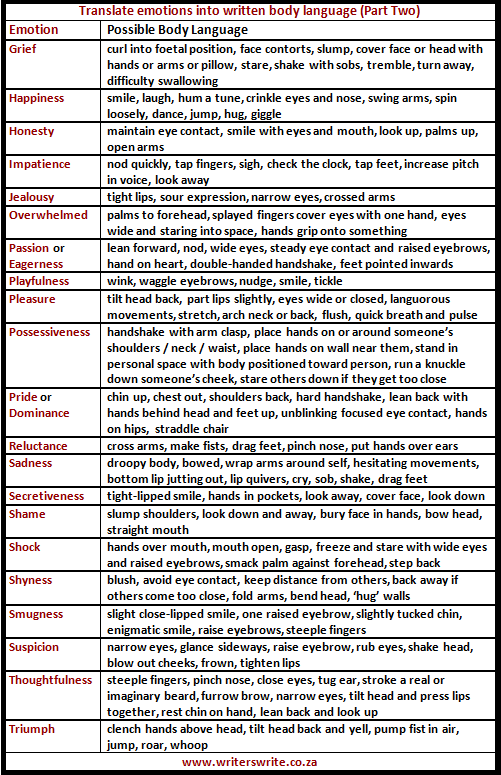
This is something that happens every day in your life. A shift of your eyebrow in skepticism, or the way your lip may twitch to a half smile cause you’re trying not to laugh. These behaviors are vital for writing in character, because not only do the allow you to visually see what is happening but it is also reaffirming whatever emotion your character is showing.
So why should you write it?
Much of human communication is non-verbal which means you need to also translate this non-verbal reaction in a post. It allows you to greatly enhance the emotions of another character and always another person to ‘visually’ see how they feel in a post. Most of all, this will add depth and volume to your post to make it feel more real. IT will make your character feel like a human instead of just another fictional person you look at from above.
Below you will find a list different type of emotions and what sort of body language can be exhibited to them.
Three ways to accent an action.
When writing about emotions, there are different ways to verbally write them out. Each one is unique in their own way, allowing you to show more about the emotion.
Emphasize the Emotion.
But doing this, you are expressing both the emotion and the body language. We’ll use a simple example. It’s short and simple yet you can sense he is happy.
John felt so happy that he was humming a tune while walking down the hall.
Complicate the Emotion.
Sometimes, even when you are feeling one emotion, deep down rooted underneath the facade of it all, there is actually an underlining emotion they feel. This is something you have to truly express otherwise no one will know.
John felt so happy that he was humming a tune while walking down the hall. However, it was obvious by the way his nose crinkled that he was disgusted by the actions beforehand. Instead, John covered it up by appearing pleased today.
Contradict the Emotion.
This is a little different than complicate. Contradicting means that you are claiming one thing when in fact its the other. In many ways, this has a variety of uses, from inner depth of the truth to what you see in person, or someone creating a wall. It could be considered a lie, but when is anything that easy?
John felt so happy that he was humming a tune while walking down the hall. In truth, once he was in the classroom, his shoulders slumped and a pout crossed his lips when no one was around, showing just how displeased he was with the situation.
Remember that you do not always have to contradict or complicate anything. Sometimes all you need to do is emphasize and that will be just fine. You don’t always have to have an underlining complicated for an emotion to make it more enhanced.
Do be afraid to use the Thesaurus to also improve an emotion. Such things as “happy” is a nice emotional word, but think of how much more powerful it is when you heard some is “overjoyed” or “content.” She how these emotions matched up with a body language can give two different styles of happiness? Mix and match to find what works best for your character at the time.
More In Depth Information
What I’ve stated above is more of a simplistic overview. IF you truly want to improve yourself, go to this
To see just how much body language can reveal about a person. You will find things such as how a person lies, how the eyes reaction, the positioning of a person in personal space, mouth, and head body language and so much more.
Use these resources to greatly increase the reactions of your character to another and create a more life-like world.
I understand how fear can be hard to capture, because everybody experiences and shows it differently and because, like all emotions, it has calibers and gradients. I think I can help you on both accounts.
Firstly: Types of fear. (I haven’t ranked these in any particular order.)
1. Anxiety: defined as “a feeling of worry, nervousness, or unease, typically about an imminent event or something with an uncertain outcome”. Separate from the disorder, when I think of anxiety I think of nail-biting, eyebrows drawn together, sweating. Anxiety is like nervousness, but heavier.
2. Nervousness: defined as “the quality or state of being nervous”, and nervous is defined as “easily agitated or alarmed; tending to be anxious; highly strung”. Nervousness is more when you don’t know whether the outcome of something is going to be good or bad (the typical fear of the unknown), whereas anxiety is the fear of a bad outcome.
3. Horror: defined as
“
an intense feeling of fear, shock, or disgust”. Horror is fear mixed mainly with disbelief or shock: for example, a scene after a shooting on the news might horrify somebody, or an account of things done at the Auschwitz camps might horrify someone.
4. Terror: defined simply as “extreme fear”. Terror is the most unadulterated of these emotions – it’s strong, bright, pure fear, plain and simple.
5. Dread: defined as “great fear or apprehension”. Dread is similar to anxiety, but heavier even than that, because the feeling implies that you already know the outcome is not good, whereas anxiety expects a bad outcome but isn’t sure.
6. Panic: defined as “sudden uncontrollable fear or anxiety, often causing wildly unthinking behavior”. This is the child of terror – the need to do something causes you to do anything.
I think that’s it for emotions – now for how to show them. (Keep in mind you don’t have to use every single one of these mannerisms/feelings for every single character – it really depends on the person.)
1. Anxiety: lip-biting, nail-biting, foot-tapping, leg-tapping, laughing a lot, falling very quiet, being irritable, panic attacks (crying, hyperventilating), shaking, nausea
2. Nervousness: queasiness, fluttery stomach, laughing a lot, nail-/lip-biting, foot-/leg-tapping
3. Horror: I can’t think of any outward signs, but a feeling of shock with a negative connotation
Oh hey– here’s a list ranked by Writing With Color’s most popular posts since opening in 2014 up till now, the start of 2017. Pulled together for the interest and usefulness for readers like you. Thank you.
Top 7 Popular Original Posts
Words for Skin Tone– This two part guide offers an array of words for describing skin color. Part I focuses on the problems with food descriptors. Part II provides alternatives. (68k+ Notes)
Writing with Color: Description Guide – Words for Skin Tone
We discussed the issues describing People of Color by means of food in Part Iof this guide, which brought rise to even more questions, mostly along the lines of “So, if food’s not an option, what can I use?” Well, I was just getting to that!
This final portion focuses on describing skin tone, with photo and passage examples provided throughout. I hope to cover everything from the use of straight-forward description to the more creatively-inclined, keeping in mind the questions we’ve received on this topic.
So let’s get to it.
S T A N D A R D D E S C R I P T I O N
B a s i c C o l o r s
Pictured above: Black, Brown, Beige, White, Pink.
“She had brown skin.”
This is a perfectly fine description that, while not providing the most detail, works well and will never become cliché.
Describing characters’ skin as simply brown or beige works on its own, though it’s not particularly telling just from the range in brown alone.
C o m p l e x C o l o r s
These are more rarely used words that actually “mean” their color. Some of these have multiple meanings, so you’ll want to look into those to determine what other associations a word might have.
Complex colors work well alone, though often pair well with a basic color in regards to narrowing down shade/tone.
For example: Golden brown,russet brown, tawny beige…
As some of these are on the “rare” side, sliding in a definition of the word within the sentence itself may help readers who are unfamiliar with the term visualize the color without seeking a dictionary.
“He was tall and slim, his skin a russet, reddish-brown.”
Comparisons to familiar colors or visuals are also helpful:
“His skin was an ochre color, much like the mellow-brown light that bathed the forest.”
M o d i f i e r s
Modifiers, often adjectives, make partial changes to a word.The following words are descriptors in reference to skin tone.
D a r k – D e e p – R i c h – C o o l
W a r m – M e d i u m – T a n
F a i r – L i g h t – P a l e
Rich Black, Dark brown, Warm beige, Pale pink…
If you’re looking to get more specific than “brown,” modifiers narrow down shade further.
Keep in mind that these modifiers are not exactly colors.
As an already brown-skinned person, I get tan from a lot of sun and resultingly become a darker,deeper brown. I turn a pale, more yellow-brown in the winter.
While best used in combination with a color, I suppose words like “tan”“fair” and “light” do work alone; just note that tan is less likely to be taken for “naturally tan” and much more likely a tanned White person.
Calling someone “dark” as description on its own is offensive to some and also ambiguous. (See: Describing Skin as Dark)
U n d e r t o n e s
Undertones are the colors beneath the skin, seeing as skin isn’t just one even color but has more subdued tones within the dominating palette.
Mentioning the undertones within a character’s skin is an even more precise way to denote skin tone.
As shown, there’s a difference between say, brown skin withwarm orange-red undertones (Kelly Rowland) and brown skin with cool, jewel undertones (Rutina Wesley).
“A dazzling smile revealed the bronze glow at her cheeks.”
“He always looked as if he’d ran a mile, a constant tinge of pink under his tawny skin.”
Standard Description Passage
“Farah’s skin, always fawn, had burned and freckled under the summer’s sun. Even at the cusp of autumn, an uneven tan clung to her skin like burrs. So unlike the smooth, red-brown ochre of her mother, which the sun had richened to a blessing.”
Here the state of skin also gives insight on character.
Note my use of “fawn” in regards to multiple meaning and association. While fawn is a color, it’s also a small, timid deer, which describes this very traumatized character of mine perfectly.
Though I use standard descriptions of skin tone more in my writing, at the same time I’m no stranger to creative descriptions, and do enjoy the occasional artsy detail of a character.
C R E A T I V E D E S C R I P T I O N
Whether compared to night-cast rivers or day’s first light…I actually enjoy seeing Characters of Colors dressed in artful detail.
I’ve read loads of descriptions in my day of white characters and their “smooth rose-tinged ivory skin”, while the PoC, if there, are reduced to something from a candy bowl or a Starbucks drink, so to actually read of PoC described in lavish detail can be somewhat of a treat.
Still, be mindful when you get creative with your character descriptions. Too many frills can become purple-prose–like, so do what feels right for your writing when and where.
Not every character or scene warrants a creative description, either. Especially if they’re not even a secondary character.
Using a combination of color descriptions from standard to creative is probably a better method than straight creative. But again, do what’s good for your tale.
Now before you run off to compare your heroine’s skin to the harvest moon or a cliff side, think about the associations to your words.
When I think cliff, I think of jagged, perilous, rough. I hear sand and picture grainy, yet smooth. Calm. mellow.
So consider your character and what you see fit to compare them to.
Also consider whose perspective you’re describing them from. Someone describing a person they revere or admire may have a more pleasant, loftier description than someone who can’t stand the person.
“Her face was like the fire-gold glow of dawn, lifting my gaze, drawing me in.”
“She had a sandy complexion, smooth and tawny.”
Even creative descriptions tend to draw help from your standard words.
F L O W E R S
Pictured above: Calla lilies, Western Coneflower, Hazel Fay, Hibiscus, Freesia, Rose
It was a bit difficult to find flowers to my liking that didn’t have a 20 character name or wasn’t called something like “chocolate silk” so these are the finalists.
You’ll definitely want to avoid purple-prose here.
Also be aware of flowers that most might’ve never heard of. Roses are easy, as most know the look and coloring(s) of this plant. But Western coneflowers? Calla lilies? Maybe not so much.
“He entered the cottage in a huff, cheeks a blushing brown like the flowers Nana planted right under my window. Hazel Fay she called them, was it?”
These ones are kinda odd. Perhaps because I’ve never seen these in comparison to skin tone, With the exception of amber.
At least they’re common enough that most may have an idea what you’re talking about at the mention of “pinecone.“
I suggest reading out your sentences aloud to get a better feel of how it’ll sounds.
"Auburn hair swept past pointed ears, set around a face like an acorn both in shape and shade.”
I pictured some tree-dwelling being or person from a fantasy world in this example, which makes the comparison more appropriate.
I don’t suggest using a comparison just “cuz you can” but actually being thoughtful about what you’re comparing your character to and how it applies to your character and/or setting.
W O O D
Pictured above: Mahogany, Walnut, Chestnut, Golden Oak, Ash
Wood can be an iffy description for skin tone. Not only due to several of them having “foody” terminology within their names, but again, associations.
Some people would prefer not to compare/be compared to wood at all, so get opinions, try it aloud, and make sure it’s appropriate to the character if you do use it.
“The old warlock’s skin was a deep shade of mahogany, his stare serious and firm as it held mine.”
These are trickier to use. As with some complex colors, the writer will have to get us to understand what most of these look like.
If you use these, or any more rare description, consider if it actually “fits” the book or scene.
Even if you’re able to get us to picture what “rutile” looks like, why are you using this description as opposed to something else? Have that answer for yourself.
“His skin reminded her of the topaz ring her father wore at his finger, a gleaming stone of brown, mellow facades.”
P H Y S I C A L D E S C R I P T I ON
Physical character description can be more than skin tone.
Show us hair, eyes, noses, mouth, hands…body posture, body shape, skin texture… though not necessarily all of those nor at once.
Describing features also helps indicate race, especially if your character has some traits common within the race they are, such as afro hair to a Black character.
How comprehensive you decide to get is up to you. I wouldn’t overdo it and get specific to every mole and birthmark. Noting defining characteristics is good, though, like slightly spaced front teeth, curls that stay flopping in their face, hands freckled with sunspots…
G E N E R A L T I P S
Indicate Race Early: I suggest indicators of race be made at the earliest convenience within the writing, with more hints threaded throughout here and there.
Get Creative On Your Own: Obviously, I couldn’t cover every proper color or comparison in which has been “approved” to use for your characters’ skin color, so it’s up to you to use discretion when seeking other ways and shades to describe skin tone.
Skin Color May Not Be Enough: Describing skin tone isn’t always enough to indicate someone’s ethnicity. As timeless cases with readers equating brown to “dark white” or something, more indicators of race may be needed.
Describe White characters and PoC Alike: You should describe the race and/or skin tone of your white characters just as you do your Characters of Color. If you don’t, you risk implying that White is the default human being and PoC are the “Other”).
PSA: Don’t use “Colored.” Based on some asks we’ve received using this word, I’d like to say that unless you or your character is a racist grandmama from the 1960s, do not call People of Color “colored” please.
Not Sure Where to Start? You really can’t go wrong using basic colors for your skin descriptions. It’s actually what many people prefer and works best for most writing. Personally, I tend to describe my characters using a combo of basic colors + modifiers, with mentions of undertones at times. I do like to veer into more creative descriptions on occasion.
Want some alternatives to “skin” or “skin color”?Try:Appearance, blend, blush, cast, coloring, complexion, flush, glow, hue, overtone, palette, pigmentation, rinse, shade, sheen, spectrum, tinge, tint, tone, undertone, value, wash.
I tried to be as comprehensive as possible with this guide, but if you have a question regarding describing skin color that hasn’t been answered within part I or II of this guide, or have more questions after reading this post, feel free to ask!









 Nothing but My Aching Soul