if the element is always performed in every program for years
if an element is performed better than most other people could ever hope for,
if an element is so unique or unused that they are one of very few skaters to do it
if they popularize the element
if the element is used in an iconic performance
Points 1 and 3 in particular apply to elements besides jumps – like certain spin positions and choreographic elements. Those are the real moves that make you go “Ah, yes, this is a Michelle Kwan/Yuzuru Hanyu/Victor Nikiforov program.” Point 2 is what makes a normal spin position or element into something they “own.”
Point 4 – you might see many other competitors start trying out a move because X-skater is super popular and does it in his programs. The move becomes tied to his name because he’s inspiring a new generation of skaters – he has an impact on others and they think of him whenever they try the move.
For example:
(Yuzuru Hanyu, his Layback Ina Bauer. 2016/17 EX Notte Stellata. This gif is from a gala practice.) Point 1: Even though Yuzuru’s layback ina bauer isn’t a new move, and even though many Ladies can do it, it’s one of his signature moves because he’s put it in one of his programs every year since he was a Junior (9 years of programs). You watch his programs expecting it to appear this year too. “It’s not a Yuzu program unless it has an ina bauer.” Point 3: Not many other men can do a layback version of the ina bauer because it requires a certain amount of flexibility in the back, thus making it rare to see in the men’s field (especially as they get older). Point 2: Even if other top skaters try putting it in their programs now, the quality of Yuzu’s will set his apart. Point 4: Because Yuzuru is now famous, you’ll find an increase in videos of younger skaters including the layback ina bauer in their programs. Where it used to be sort of feminine, now younger male skaters are starting to use it because they want to emulate him.
Point 5 – imagine this scenario: It’s the World Championships and young Victor is behind a couple of points going into the Free. Everyone in the last group of skaters is neck-and-neck and anyone could be on that podium. His older competitors are doing well with their Free Skates and it’s such an exciting competition for the spectators that the atmosphere in the venue is electric. Finally it’s Victor’s turn. The tension is palpable, and commentators are wondering if this teen will win the gold in just his second appearance at the World Championships. He goes out there and performs his program the best he has ever done it. It’s such a gorgeous performance that he shatters the World Record by a ridiculous margin, and wins the event in such a way as to leave the spectators in awe. Commentators are calling this “one of the best programs in the history of figure skating – if not THE best.” “The program moved me to tears.” “It was such a touching performance, I couldn’t take my eyes off him.” It makes such headlines, goes viral in the figure skating community, and spreads to news reports in countries where figure skating is popular.
Somewhere near the end at a music climax he does a long spiral, and the cameras catch it at multiple angles. He’s done this move many times in the past, other men have done this move (although rarely), women do this move all the time. It’s not like it’s a new move, but this record-breaking program with the spiral set right at a climactic moment makes the spiral his signature move. It becomes associated with his name and people say: “Hey, remember that move in the program by that silver-haired skater, Victor?” “The spiral? You’re talking about the move with the leg up, right?” “Oh, is that what it’s called? Yeah, that’s the one. That was gorgeous – Victor’s spiral.”
Just as the long hair was likely his signature look for many years, the spiral becomes attached to his image. When he does the spiral from then on, commentators will call it his signature move because it’s recognizable as HIS move from that one really amazing performance.
(This is a made-up headcannon based on his spiral at Junior Worlds. Please don’t take it as canon.)
Point 2:
if a move is performed better than most other people could ever hope for – this is where jumps become signature moves
The key is for the difficult jump to be performed cleanly and consistently. We’re talking +3GOE quality here. Or alternatively, if the skater is one of the few who jump that particular one (4Lo, 4F, 4Lz). Let me use in-series and real-life examples.
Yuuri is known for his 3A – it seems that he usually lands it with good form. I’m sure over the years he hasn’t fallen on it very often in competition and thus it became a jump that commentators and people in the FS world know him for. But that’s not exactly a signature move in the sense that you wait an entire program to see it. It’s signature in the sense that he’s known for being one of the best at it. Then we have Victor with his 4F. I’ll bet you that he was the first man to land this jump, but if he wasn’t, then he was definitely the one to land it consistently and cleanly in competitions. He’s known for it because of the quality and probably because he always puts a 4F his programs. Perhaps it’s even his favorite quad.
Looking at real-life skaters:
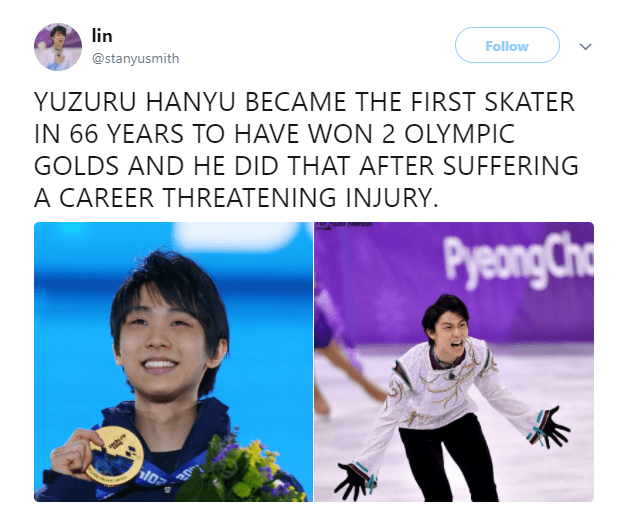
Yuzuru is known for his 3A. Of course, every Senior Men’s skater has to be able to do a 3A, and there are some currently competing skaters with beautiful 3As of their own, but Yuzuru’s is one of the most effortless and consistent you’ll see. It’s the one jump that everyone can count on when all other jumps fail in his program. He can do a 3A from standstill, he can do 4T-3A-3A-3A chains, he can do 4Lo-3A. He does it so well and always with such difficult entries, that his 3A became the jump he is known for.
Going further back, his coach Brian Orser was known during his career in the 1980s as “Mr. Triple Axel” because he was that good at 3As. He was the first Junior to land a 3A in competition, he was the first man to land it in the Olympics. This was back in the time when the 3A was the pinnacle, and quads were for crazy dreamer athletes who cared less for points and more for achieving the impossible.
Shoma Uno is the first man to land the 4F, and he lands it well for how little time he’s competed with it (not even a full year). That’s become his signature jump and even if other skaters like Boyang Jin and Nathan Chen try it out, Shoma is the one that the jump is tied to and spectators always wait for it.
So I guess the bottom line is, even if other men do the same spins and jumps, if a skater does the element so well that it sticks in people’s minds, then it becomes their signature move.
Figure skating jumps are identified by the way the skater takes off the ice. Here are simple ways to tell them apart, using layman-friendly terms.
There are 6 different types of jumps (in order of base value): Toe loop (T), Salchow (S), Loop (Lo), Flip (F), Lutz (Lz), Axel (A).
Since Yuzuru rotates anti-clockwise in the air, these examples are for anti-clockwise jumps. For clock-wise jumpers, the left and right would reversed.
EDIT: The toe, lutz and flip can look confusingly similar. Just remember, for the toe, the skater rotates away from the foot on the ice and for the flip and lutz, the skater rotates towards the foot on the ice.


 Nothing but My Aching Soul